Follower count doubled in 4 months. SocialDog makes all metric trends clear at a glance.
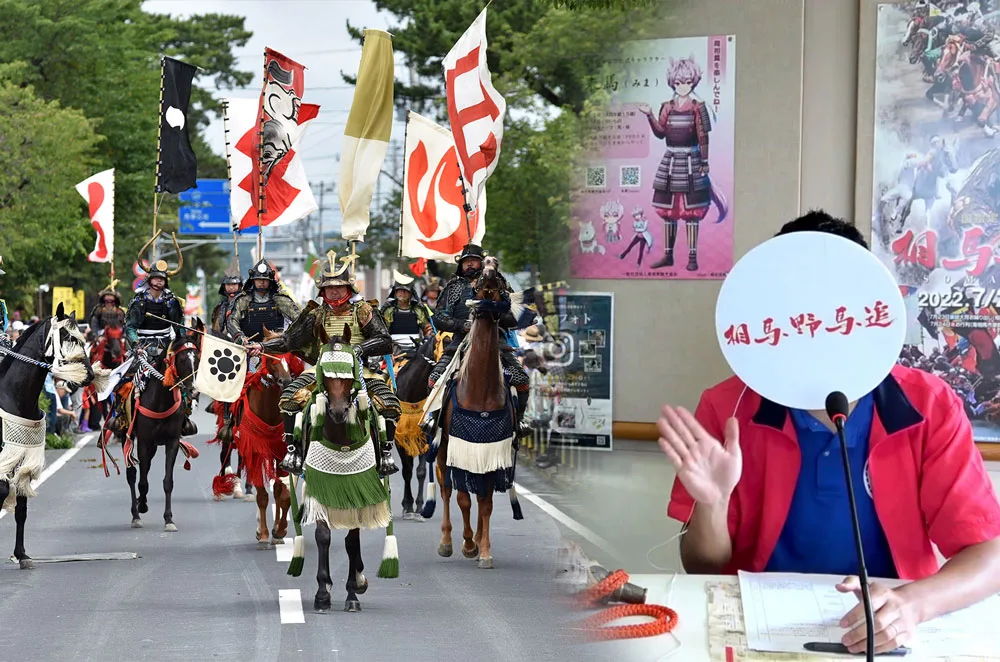
The Soma Nomaoi Executive Committee, which organizes the Nomaoi festival—an important intangible folk cultural asset—as a Shinto ritual praying for peace and tranquility in the Soma region, operates a Twitter account as part of its fan-building efforts. We asked the person in charge about the various strategies and approaches used to convey the excitement of the passionate festival through social media.
Current Operations
—Could you tell us which social media platforms you are currently using?
Twitter, Facebook, Instagram, and YouTube.
While Instagram and Facebook can be linked to post to both simultaneously, our update frequency for them is low.
Currently, we focus primarily on Twitter, updating it most frequently in real-time.
Although we created accounts for all platforms around the same time, I personally had more expertise with Facebook, so we primarily managed Facebook for the first two years or so.
However, we struggled to spread information as effectively as we hoped.
Then, through books and seminars, I learned that Twitter allows for more casual information sharing and proactive communication with others. I felt that this approach would be ideal for spreading information, so we gradually shifted our focus to Twitter.
—After focusing your efforts, did you feel that information spreads more easily on Twitter?
Yes, that's right.
While Facebook allowed us to see reactions to posts numerically through likes, we didn't really feel the sense of diffusion.
On the other hand, Twitter's retweet function is frequently used, and as our follower count grew, so did our sense of information spreading.
Operations started during the pandemic. Building a fan base with social media.
—When did you start operating your social media accounts?
We created the accounts in June 2020, so a little over two years ago.
Around that time, the COVID-19 pandemic was prevalent, and there was uncertainty about whether events, including Soma Nomaoi, could even take place. We wondered how to disseminate information during this period, which led us to try social media.
When we first created the accounts, the goal was to run a crowdfunding campaign, so we used them to share information related to the crowdfunding, such as its duration.
Currently, our main focus is fan building.
Soma Nomaoi is not a widely known event, so our primary goal is simply to raise awareness.
When we first started, our communication was quite formal, like typical 'government information dissemination.' However, as Twitter became our main platform, we began to explore how to communicate as an 'official account.'
—What metrics do you use to measure fan building and increased awareness?
Mainly, it's the number of followers.
Also, what I've felt most throughout our operation is a sense of achievement when even posts that aren't particularly informative, or just a single photo, start receiving a consistent number of likes.
With SocialDog, results are clear at a glance with graphs. It also offers rich metrics not found in Twitter Analytics.
—What was the deciding factor for implementing SocialDog?
The visuals were the deciding factor.
As the person in charge, I felt that information was spreading after changing our communication methods, but I was afraid that my superiors and other stakeholders wouldn't understand this, and I'd be asked, 'What is that person doing?'
So, I wanted to create a report that clearly showed the trends in follower count and other metrics in a graph, making the results immediately understandable.
Originally, I used the analytics provided by Twitter, but it didn't show the number of unfollows, so I couldn't accurately track the net increase in followers.
Therefore, I wanted to 'be able to properly manage the numbers' and, furthermore, for it to be 'visually easy to understand,' which led me to SocialDog.
—How has it been since you implemented it?
I felt that SocialDog alone was sufficient for the detailed numbers and visual aspects.
I've been able to report consistent growth.
Thanks to that, I haven't been reprimanded for operating it as I like (laughs).
Does visibility of results expand possibilities? Follower count more than doubled with flexible operation.
Visualized results expand the scope of what can be done.
—Have there been any changes since implementation?
I feel that being able to demonstrate results has continuously expanded the 'safe zone' for what we can do, making it easier to try various things.
For example, this applies to operating with a strong 'insider' feel, as well as running campaigns.
If we were to do these things in an environment where it's difficult to show results, we'd likely be asked, 'What are you doing?' So, being able to clearly show the operational results to non-stakeholders is truly beneficial when experimenting with different approaches.
—Could you tell us specifically what you've been able to do?
It's about adopting a frank operating style that emphasizes the 'person behind the account' and running campaigns.
When we first started, I looked at how other organizations hosting similar traditional events were tweeting. From what I observed, few were effectively leveraging Twitter's characteristics to spread information, and I felt it would be difficult to disseminate information simply by emphasizing the length of tradition.
I felt that a communication style similar to corporate official accounts of private companies—using a light touch to engage with fans and others on a daily basis—was closer to my ideal for information diffusion. In fact, I thought the gap created by presenting something traditional with new methods might be well-received. That's why the Soma Nomaoi Executive Committee also tries to communicate with a light touch.
To achieve this, we constantly work on our language and creating a specific atmosphere when posting on Twitter.
I believe few people would reply with 'Good morning' to information disseminated by a government office.
The Soma Nomaoi Executive Committee aims to maintain an account atmosphere where people feel comfortable greeting us, asking questions, and believe that whatever they say will be accepted.
—What prompted you to start running campaigns?
Originally, we recognized the inherent strength of content like Soma Nomaoi, with its samurai and mounted warriors. However, we were exploring how to introduce the Nomaoi to people who had no interest in samurai or horses and get them interested.
So, as part of our awareness expansion efforts, we started collaborative campaigns with companies from completely unrelated industries.
In the past, we collaborated with Daisho Co., Ltd., known for their 'Hitofuri 3-yaku Aji Shio Kosho' (a 3-in-1 seasoned salt and pepper), and Teijin Limited, known for 'DAKE JA NAI'.
It's great that SocialDog shows you the times when impressions are likely to increase.
Also, when running campaigns, downloading keyword search results as a CSV has, I believe, made it less likely to miss checking applicants.
This year, in particular, thanks to our plan to continuously collaborate with major companies from April to June and leading up to the main Nomaoi event in July, our follower count, which was just under 6,000 around April 2022, approximately doubled in about four months.
We have already reached out to several companies and plan to continue running collaborative campaigns in the future.
Aiming for even more authentic communication.
What do you want to do next?
I believe that relying solely on tweets limits our capabilities. Therefore, I want to use Twitter Spaces and YouTube to directly answer questions from fans and followers in real-time, fostering more authentic interactions.
While strengthening connections is important, I also want to understand what my followers truly want.
Although I usually post many photos, there might be requests like 'I want to see more videos' or 'I want you to do live streams.'
I want to listen carefully to those voices and implement what's feasible.